REACH & IMPACT
Good communication should leave a clear record.
A finished feature is something you can show people; the campaign that carried it should be just as easy to look back on.
We pair the creative work with an agreed plan for publishing, promotion and measurement, so you can see what was delivered and how audiences responded.

DIFFERENT ROUTES
Different ways into the same research
Some people will discover a short explanation in their feed. Others will open the full article, read the magazine or follow a link shared by your institution. The campaign opens up more than one route into the work, instead of leaning on publication alone.
We pick channels and formats to suit the project. Paid activity, where agreed, can extend distribution beyond existing followers. PR can put the work in front of relevant media, but we can’t promise that an independent publication will cover it.
THE REPORT
What the report helps you understand
The work delivered.
The feature, publication links and agreed supporting assets.
Where it appeared.
The channels used, campaign dates and relevant placements.
Exposure.
The impressions, reach or video-view measures reported by the relevant platforms.
Response.
Recorded interactions, onward clicks and downloads where available.
The limits.
What each measure represents and what the available evidence cannot establish.
DEFINITIONS
Big numbers need clear definitions
An impression records a display, not a completed read. Reach is a platform’s measure of accounts or people reached within a defined period, not automatically a deduplicated audience across every channel. A video view and a completed video play are different measures.
We explain the figures used in each report, identify paid and organic activity, and keep different measures separate rather than combining them into an inflated total.

BEYOND THE NUMBERS
Reach is a beginning, not the whole impact story
Distribution figures can document visibility and audience response. They do not, on their own, show that someone understood the research, changed their behaviour or experienced a health benefit. Where deeper outcomes can be evidenced, they deserve to be recorded separately.
PREVIOUS WORK
See the work behind the report
The examples below come from previous Scrolly Science projects. They demonstrate relevant creative and campaign experience, not an established readership or guaranteed result for the new magazine.

CASE STUDY 01 / PREVIOUS SCROLLY SCIENCE PROJECT
Molecular Guardians: making complex biology visible
Scrolly Science worked with Professor Nicolas Bazan on a two-minute animated film built around his research on elovanoids. The production translated a complex subject into an illustrated account that people could watch without specialist knowledge.
The published project is the finished film. A separate campaign report records paid distribution across Meta and Google/YouTube during June 2026. Together, the creative work and the reporting offer two different kinds of evidence: what was made, and how it was distributed.
This was a Scrolly Science animation project, not a feature commissioned for The Researcher magazine. Its scope and campaign results should not be treated as a standard magazine package.

CASE STUDY 02 / PREVIOUS SCROLLY SCIENCE PROJECT
Mind Captioning: one project, several ways to engage
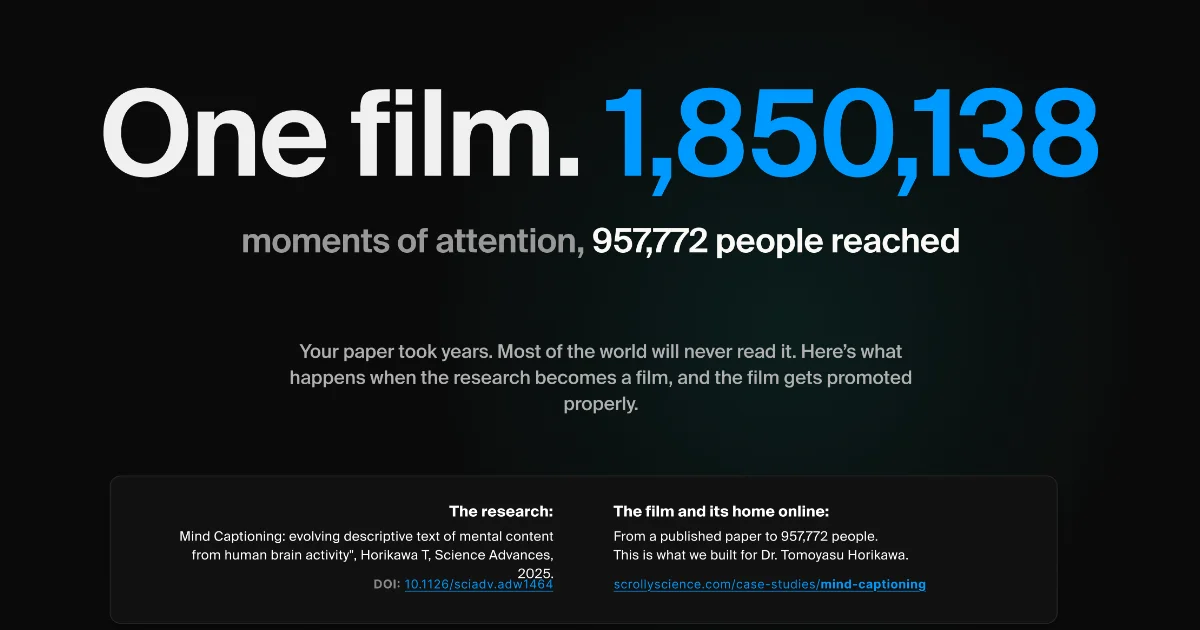
For Dr Tomoyasu Horikawa, Scrolly Science produced a short animated explainer, a dedicated research website and a plain-English article. The project illustrates how one body of research can be presented through complementary formats, each giving audiences a different way to explore it while preserving the research’s meaning.
FROM A PREVIOUS PROJECT
“I truly appreciate the care and thoughtfulness with which you handled my comments and scientific nuances throughout the process.”
Dr Tomoyasu Horikawa
Feedback on his Scrolly Science project, not on The Researcher magazine.