Can you get out and about?

Topic:
Technology & Society
I know a couple in their mid-70’s who moved recently into an older adult community. They opted for the independent living portion of the community because that is the way they think of themselves and in part because they wanted to continue to remain physically active. They looked at four or five older adult communities before committing to the one they ultimately choose, determining a livability score for each based on things important to them: sidewalks and roadway crossing, especially to nearby destinations; bicycle network completeness and stress level, access to public transit, permeability of the community to surrounding neighborhoods.
This couple is not unique. They reflect lifestyle preferences of many older adults who choose to live in an intentional community. In response, developers are creating communities that meet this market. While the number of available apartments is increasing as new communities come online, there is competition for these units with waiting lists forming as soon after the ‘first keyholders’ grab their units.
Shifting Community Models
Modern communities are moving away from traditional models, focusing instead on:
Active Adult (55+) Communities:
Targeted at healthy, independent retirees, these communities focus on resort-style amenities, social programming, and maintenance-free living without on-site medical care.
Continuing Care Retirement Communities (CCRCs):
These communities allow residents to transition seamlessly from independent living to assisted living or skilled nursing as their care needs change over time.
Solo Aging & Renting:
There is a strong trend of older adults choosing to rent rather than own, with individuals aged 65 to 74 comprising the fastest-growing cohort of renters.
Older adult communities are also responding to increasing demand for older adults who want a focus on ‘health, wellness, and lifestyle’. For many, aging with active lifestyle is replacing aging in place. A recent Pricewaterhouse Coopers report notes that older adult communities are … shifting from reactive to proactive care, focusing on preventative health and holistic approaches to wellness while prioritizing lifestyle and engagement programming in daily life. Amenities such as walking trails and dog parks are popular in active adult communities, while wellness spaces that foster resident-led activities and social engagement are increasingly important across the senior housing continuum.
While developers understand this new market and offer new models of older adult communities (see the text box to the right), many jurisdictions do not include these communities planning for active mobility infrastructure. Public engagement, data analysis, and scoring processes typically exclude older adult communities. Further, many older adult communities are gated so that access in and out, i.e., permeability, is limited and often through a motor vehicle driveway entrance. Fences and few access points ignore the particular mobility needs of an older adult community residents and staff.
Some cities proudly include a 55+ community in a transit-oriented development project or in a new neighborhood with good walking, cycling, and transit service. While this is a positive step, existing older adult communities can be left out. It also relieves the jurisdiction of considering older adult communities specifically by including them as part of a larger development.
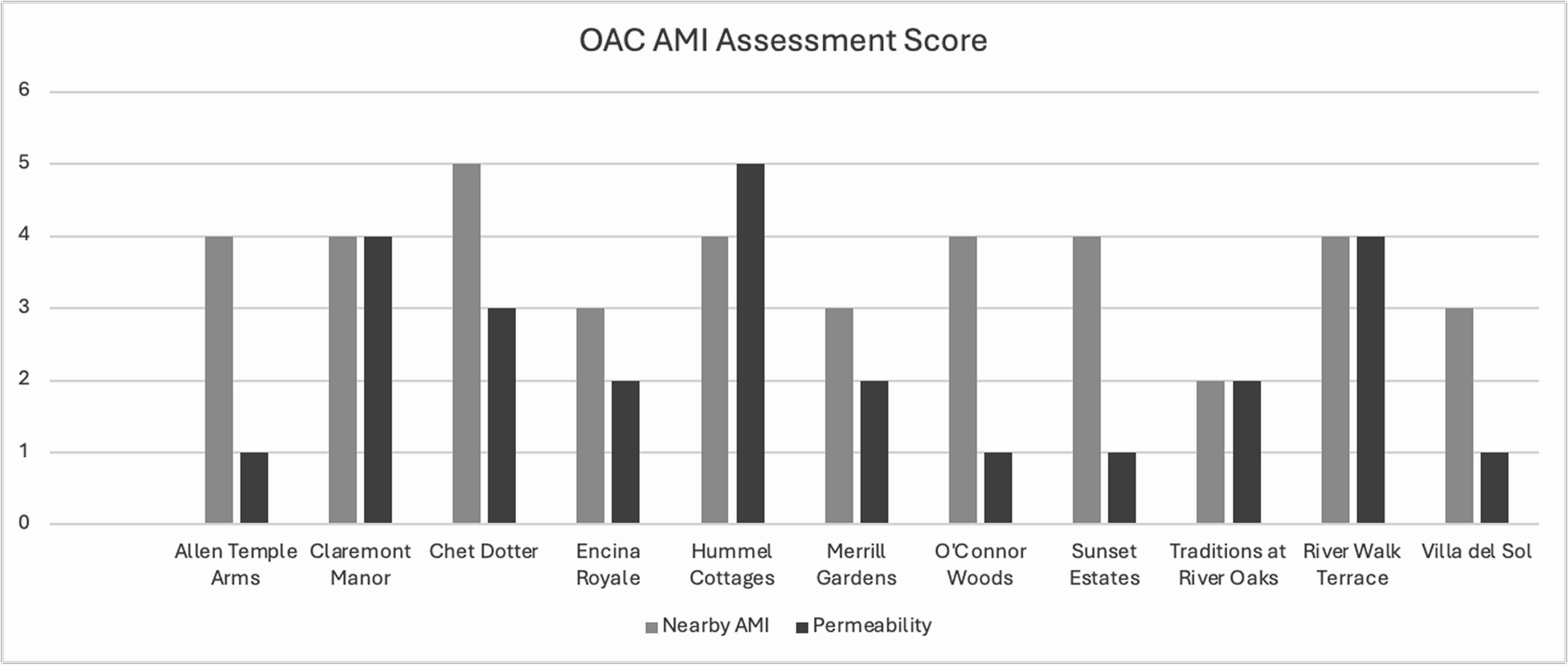
We completed a study in 2022 of 10 older adult communities asking the question about if and how active mobility infrastructure, such as a pedestrian and cycling network, and a robust public transit system, is available to its residents both on-site and in surrounding neighborhoods, and how easy it is to go between the two, i.e., its permeability.
We developed a new scoring system to evaluate mobility of older adult community residents (and staff) and the surrounding areas.
Planning activity | Older Adult Community Recognition |
|---|---|
Engaging older adults communities to learn about mobility in older adult communities |
|
Identifying older adult communities and their residents as factors in an active mobility infrastructure plan |
|
Analyzing safety risks and including the results on things such as a ‘heat map’ |
|
Prioritising identified infrastructure needs and operation |
|
Selecting projects for short-term funding that benefit older adult communities |
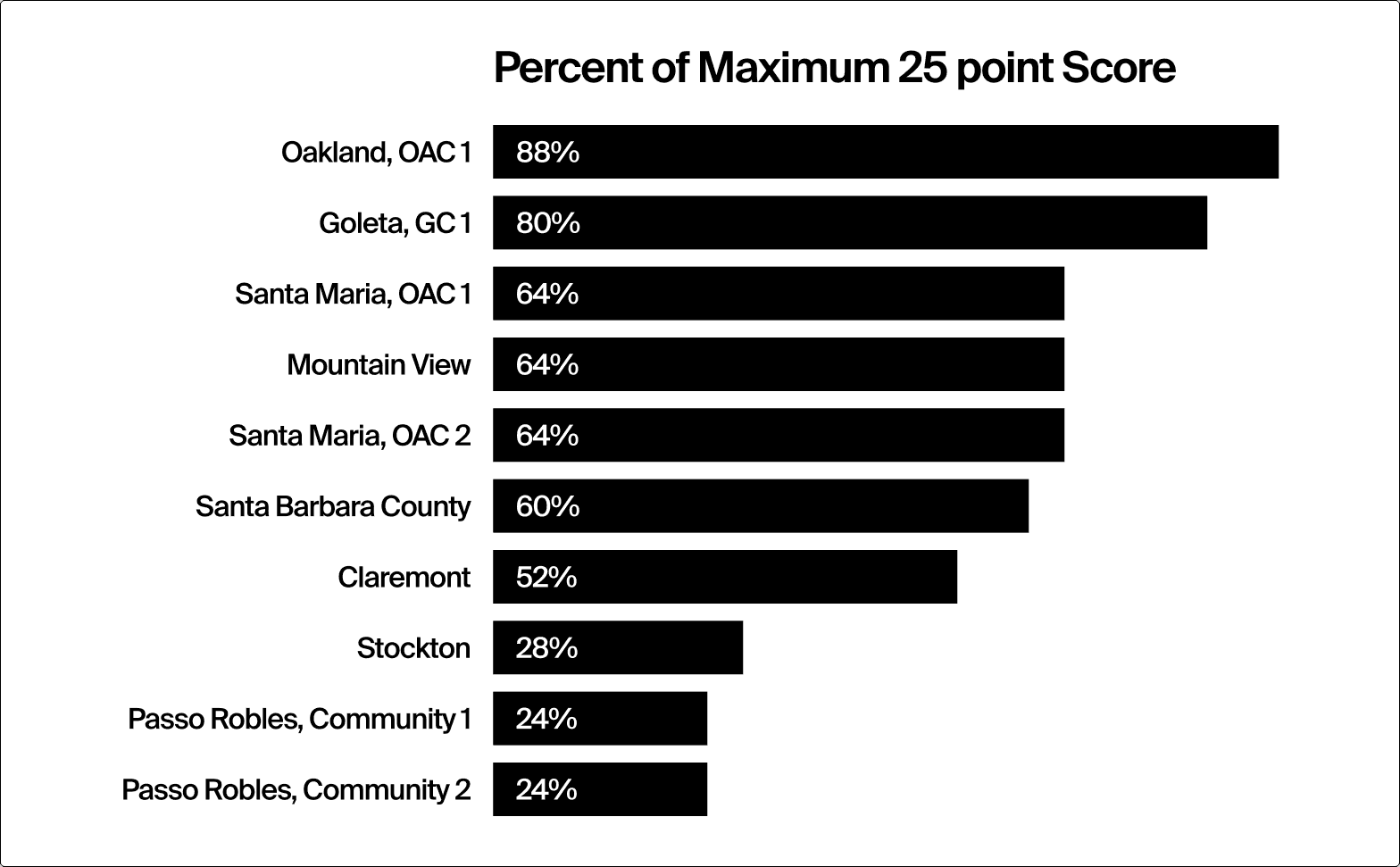
We scored jurisdictions on five activities typically included in active mobility infrastructure planning in the study area, rating jurisdictions on a 5-point Likert scale. None of the jurisdictions studied received the full 25-point score.
A simple change in the way active mobility infrastructure is done can help match up neighborhoods surrounding older adult communities with their residents.
Is this level of attention to older adult communities warranted? ‘Active living’ and tiered living older adult communities often have complete and functional active mobility infrastructure on-site. Developers and community staff may assume that residents want to and will stay within the confines of the community if enough physical activity features exist. Residents may move there to live in an intentionally cocooned community. However, lower income communities do not benefit from extra land to install physical activity features outside and within their boundaries. So, developers have an economic question about how to get the most return on their investment.
The urgency of addressing active mobility infrastructure in and around older adult communities will only grow. By 2030, all baby boomers will be over the age of 65, swelling the older adult population to unprecedented levels and driving demand for communities that support active, engaged lifestyles.
Today's retirees are not their grandparents' generation. Advances in healthcare, nutrition, and preventative medicine mean that many people entering older adult communities in their mid-70s can reasonably expect another 15 to 20 years of active, independent life. Many want and expect an active lifestyle.
Planning for walkable, bikeable, and transit connected communities is not a niche concern; it is an investment in infrastructure that will serve a growing share of the population for decades to come.
Jurisdictions, developers, and planners who fail to account for the mobility needs of older adults risk building communities that age poorly alongside their residents, while those who rise to the challenge have an opportunity to define a new standard of livability for one of the fastest growing demographic groups in the modern world.